
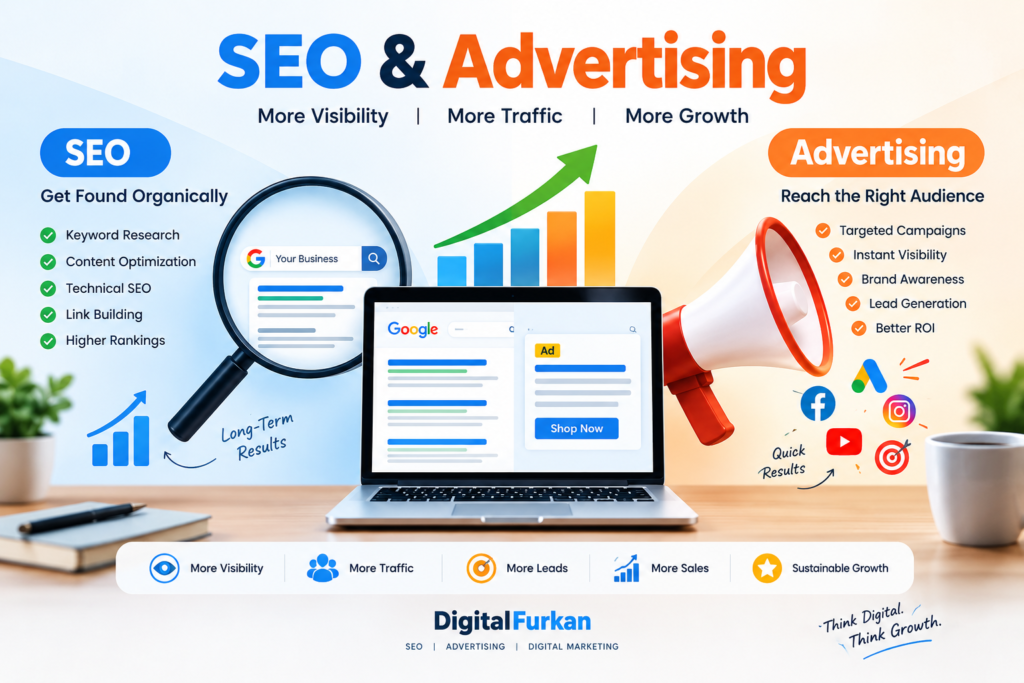
The Complete Guide to Digital Growth
Introduction
In today’s digital world, having a website is not enough. Businesses need to make sure that their brand can be discovered by the right audience at the right time.
Two powerful digital marketing strategies that help businesses achieve this are SEO (Search Engine Optimization) and Online Advertising.
SEO focuses on improving organic visibility in search engines, while advertising uses paid campaigns to reach targeted audiences.
When used together strategically, SEO and advertising can support brand awareness, website traffic, leads and business growth.
PAGE 1 — What Is SEO?
SEO stands for Search Engine Optimization.
It is the process of improving a website so that search engines can better understand its content and users can easily discover relevant information.
SEO can involve:
- Keyword research
- Content optimization
- Technical SEO
- Website structure
- Internal linking
- Page experience
- Search intent
- Content quality
For example, if someone searches for “digital marketing agency”, businesses want their relevant pages to be easy for search engines and users to discover.
SEO is generally a long-term marketing activity rather than an instant traffic solution.
PAGE 2 — Why SEO Is Important
Search engines are an important way for people to discover information, products and services.
A strong SEO strategy can help a business:
- Increase organic visibility
- Attract relevant visitors
- Build online authority
- Reach people searching for specific solutions
- Create long-term content assets
- Improve website discoverability
The key is to focus on providing useful information rather than simply inserting keywords into a page.
Search Intent
Understanding why someone searches for something is an important part of SEO.
A person searching for:
“What is SEO?”
may want educational information.
Someone searching for:
“SEO agency near me”
may be looking for a service.
Understanding this difference helps marketers create more relevant content.
PAGE 3 — Keyword Research
Keywords are words and phrases people use when searching online.
Keyword research helps marketers understand what their audience is looking for.
Examples include:
- Digital marketing agency
- SEO services
- Social media marketing
- Google advertising
- Website development
- AI marketing
However, choosing keywords should not be based only on search volume.
Marketers should also consider:
- Search intent
- Relevance
- Competition
- Business goals
- Audience needs
The best keyword is one that connects the user’s search with genuinely useful content or a relevant business offering.
PAGE 4 — On-Page SEO
On-page SEO focuses on elements that can be improved on a webpage.
Important areas include:
Page Title
A clear and relevant title helps users understand what the page is about.
Headings
Organized headings make content easier to understand.
Content
Content should be useful, accurate and relevant to the audience.
Internal Links
Internal links help users and search engines navigate related pages.
Images
Relevant images can improve the visual experience when properly optimized.
Meta Description
A concise description can help users understand what they may find on a search result.
Good on-page SEO combines search optimization with a good user experience.
PAGE 5 — Technical SEO
Technical SEO focuses on the technical aspects of a website that can affect crawling, indexing and user experience.
Areas can include:
- Website speed
- Mobile usability
- Site architecture
- HTTPS
- XML sitemaps
- Structured data
- Crawlability
- Indexing
A technically healthy website gives search engines a clearer understanding of its pages.
Technical SEO should work together with valuable content and good website design.
PAGE 6 — What Is Online Advertising?
Online advertising is paid promotion through digital platforms.
Businesses can use advertising to reach specific audiences based on factors such as:
- Search queries
- Interests
- Demographics
- Location
- Online behaviour
- Previous interactions
Common digital advertising formats include:
Search Ads
Ads that can appear when people search for relevant terms.
Display Ads
Visual advertisements displayed across websites and digital platforms.
Social Media Ads
Paid promotional content distributed through social networks.
Video Ads
Advertising delivered through online video platforms.
PAGE 7 — SEO vs Advertising
SEO and advertising work differently.
| SEO | Advertising |
|---|---|
| Focuses on organic visibility | Uses paid placements |
| Often takes time to develop | Can generate visibility quickly |
| Builds long-term content value | Campaigns run according to budget and settings |
| Focuses heavily on search relevance | Can target selected audiences |
| Requires continuous optimization | Requires campaign and budget management |
Neither approach needs to replace the other.
A business can use SEO for long-term organic visibility while using advertising for specific campaigns, launches or immediate promotional objectives.
PAGE 8 — Combining SEO and Advertising
A powerful digital marketing strategy can combine both approaches.
For example:
Step 1 — SEO
Create useful content around important customer questions.
Step 2 — Advertising
Promote selected products, services or landing pages through paid campaigns.
Step 3 — Analyze
Review traffic, engagement, leads and conversions.
Step 4 — Optimize
Improve content and campaigns based on the available data.
Step 5 — Repeat
Continue testing and improving the strategy.
This creates a continuous marketing cycle:
Research → Create → Promote → Measure → Optimize
PAGE 9 — Measuring Performance
Digital marketing becomes more effective when performance is measured.
Important metrics can include:
Organic Traffic
Visitors arriving through unpaid search results.
Click-Through Rate
The percentage of users who click an advertisement or search result after seeing it.
Conversion Rate
The percentage of visitors who complete a desired action.
Cost Per Lead
The amount spent to generate a lead through a paid campaign.
Return on Advertising Spend
A metric used to evaluate advertising revenue relative to advertising spend.
Businesses should select metrics according to their specific objectives rather than focusing only on traffic or clicks.
PAGE 10 — The Future of SEO & Advertising
SEO and advertising continue to evolve as search engines, AI systems, social platforms and consumer behaviour change.
Modern marketers increasingly need to understand:
- AI-powered search
- Content strategy
- Search intent
- First-party data
- Marketing analytics
- Personalization
- Automation
- Paid media
- User experience
The future of digital marketing will not be about choosing between SEO and advertising.
It will be about understanding when and how different channels can work together.
Final Thoughts
SEO helps businesses build discoverability through organic search, while advertising provides paid opportunities to reach selected audiences.
A strong digital strategy can combine both.
SEO builds visibility.
Advertising creates targeted reach.
Content builds trust.
Analytics guides decisions.
Strategy connects everything.
DigitalFurkan
SEO | Advertising | Digital Marketing | AI Marketing | Social Media | Digital Growth
Think Digital. Think Growth.